
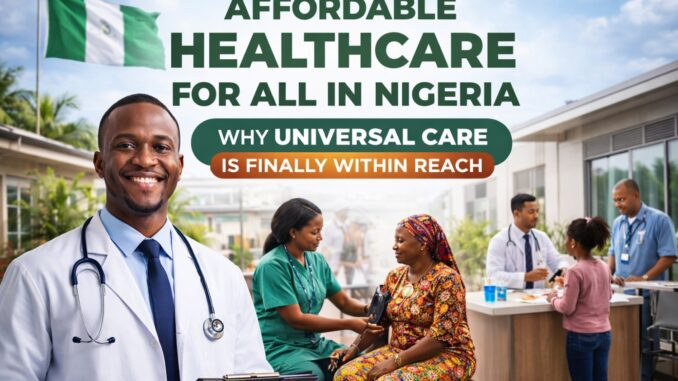
Nigeria is at a defining moment in its development journey. With a rapidly growing population, vast human capital, and abundant natural resources, the country possesses not only the capacity but also the moral obligation to guarantee affordable healthcare for all its citizens. For decades, universal healthcare in Nigeria has been discussed as a long-term aspiration—important, necessary, but seemingly unattainable. Today, that perception is changing.
Universal Health Coverage (UHC) is no longer an abstract policy slogan. It is increasingly a realistic national objective. Policy reforms, demographic pressures, economic realities, and private-sector innovation are converging in ways Nigeria has never experienced before. While challenges remain, the foundations required to deliver affordable healthcare at scale are now stronger than at any previous point in the country’s history.
The critical question has shifted. It is no longer whether Nigeria can achieve affordable healthcare for all, but how decisively it chooses to act.
Understanding Affordable Healthcare in the Nigerian Context
Affordable healthcare does not mean free healthcare, nor does it mean low-quality care. In the Nigerian context, affordability refers to access to essential, quality healthcare services without exposing individuals or families to financial hardship. This definition aligns with the global framework of Universal Health Coverage, which emphasizes access, quality, and financial protection.
Nigeria’s healthcare system has historically struggled to meet these criteria. Healthcare access has been shaped largely by income level, geography, and employment status. For many Nigerians, especially those in rural areas and the informal sector, healthcare remains a discretionary expense rather than a guaranteed public service.
This reality has been driven by a financing structure dominated by out-of-pocket payments. When healthcare costs are paid directly at the point of service, affordability collapses. Families delay treatment, rely on informal care, or abandon treatment entirely. Over time, this contributes to preventable deaths, reduced productivity, and deeper poverty.
Affordable healthcare, therefore, is not only a health issue—it is a development issue, a labor issue, and an economic issue.
From Oil to Soil: How Reviving the Green Gold Can Transform Nigeria’s Economy
The True Cost of Nigeria’s Healthcare Financing Model
Nigeria’s heavy reliance on out-of-pocket spending has had profound consequences. A significant portion of the population faces catastrophic health expenditure each year, meaning healthcare costs consume a large share of household income. This dynamic pushes vulnerable households further into poverty and discourages preventive care.
The absence of effective risk pooling means that healthcare costs are borne individually rather than collectively. In systems where insurance coverage is widespread, the healthy subsidize the sick, and the financially stable support the vulnerable. In Nigeria, that system has remained weak for decades.
The economic impact is substantial. Poor health outcomes reduce workforce productivity, increase absenteeism, and constrain long-term economic growth. No country can fully develop its human capital while healthcare remains inaccessible or unaffordable for large segments of its population.
Why Previous Healthcare Reforms Delivered Limited Results
Nigeria has not lacked healthcare policies. Over the years, several reforms were introduced with the aim of expanding access and improving outcomes. However, many failed to deliver lasting change due to structural and institutional weaknesses.
One major issue was fragmentation. Healthcare responsibilities are shared across federal, state, and local governments, often without effective coordination. Policies designed at the federal level were inconsistently implemented at the state and local levels, leading to uneven outcomes.
Another challenge was limited insurance penetration. For many years, health insurance coverage remained restricted to a small portion of formally employed workers. The informal sector—where the majority of Nigerians earn their livelihoods—was largely excluded.
In addition, weak accountability mechanisms undermined public trust. When funding allocations were not transparently managed or outcomes were poorly monitored, confidence in public healthcare initiatives declined.
These failures were not rooted in a lack of intent but in the absence of sustained political commitment, financing discipline, and institutional capacity.
Why “Now More Than Ever” Is a Defensible Claim
The current moment represents a structural shift rather than a temporary improvement. Several developments distinguish today’s healthcare landscape from previous reform cycles.
Policy and Legal Foundations Have Strengthened
The expansion of the National Health Insurance Authority (NHIA) framework has altered the healthcare financing conversation. Health insurance is no longer framed as optional or limited to certain employment categories. The legal basis for expanding coverage is stronger, and states now have clearer pathways to design inclusive insurance schemes tailored to their populations.
The Basic Healthcare Provision Fund (BHCPF) also represents a meaningful attempt to institutionalize primary healthcare financing. By dedicating a defined portion of national revenue to basic health services, Nigeria has moved closer to predictable, sustainable funding for frontline care.
While implementation challenges persist, these frameworks did not exist in this form a decade ago.
Demographic and Economic Pressures Are Forcing Reform
Nigeria’s population growth has accelerated the urgency of healthcare reform. With projections pointing toward continued expansion, the cost of inaction is rising rapidly. A young and growing population can be an economic asset only if it is healthy.
At the same time, economic constraints have made inefficiency less tolerable. Governments, businesses, and households increasingly recognize that healthcare must be financed more intelligently. The status quo is no longer sustainable.
The Private Sector Is No Longer Peripheral
Healthcare in Nigeria is no longer viewed solely as a public-sector responsibility. Private hospitals, diagnostic centers, pharmaceutical manufacturers, and health technology companies are playing an increasingly central role.
This shift matters because sustainable healthcare systems rely on mixed models—public oversight combined with private efficiency. Countries that achieved universal healthcare did not do so by excluding the private sector, but by regulating and integrating it.
Health Insurance as the Core Engine of Affordability
Health insurance remains the single most important mechanism for making healthcare affordable at scale. It spreads risk, stabilizes funding, and allows providers to plan and invest with greater certainty.
Nigeria’s challenge has never been the concept of insurance, but coverage depth and trust. For insurance to work, enrollment must be broad, contributions must be affordable, and benefits must be clear and reliable.
Recent reforms have opened the door to:
- Community-based insurance models
- Micro-insurance for informal workers
- Employer-supported schemes
- State-level insurance programs
When properly implemented, these models reduce out-of-pocket spending and protect households from financial shock.
The Central Role of Primary Healthcare
No country has achieved universal healthcare without a strong primary healthcare system. Primary care is where most health needs are met at the lowest cost.
In Nigeria, underinvestment in primary healthcare has led to overcrowded tertiary hospitals and inefficient use of limited resources. Conditions that could be managed early escalate into expensive emergencies.
Strengthening primary healthcare requires:
- Adequate staffing and fair compensation
- Reliable drug supply chains
- Basic diagnostic equipment
- Community engagement and trust
When primary care works, the entire health system becomes more affordable and efficient.
Technology and Innovation as Cost Reducers
Health technology is reshaping healthcare delivery in Nigeria. Digital platforms are reducing transaction costs, improving data management, and expanding reach to underserved communities.
Telemedicine reduces the need for physical travel. Digital pharmacies improve supply chain efficiency. Electronic health records reduce duplication and waste.
Technology alone will not solve systemic problems, but it can amplify the impact of good policy and efficient financing.
Healthcare Workforce: The Human Constraint
Infrastructure and financing mean little without skilled professionals. Nigeria faces a serious healthcare workforce challenge, driven by migration and poor working conditions.
Retention requires more than patriotic appeals. Health workers need:
- Competitive compensation
- Safe working environments
- Clear career progression
- Professional respect
Addressing workforce challenges is essential for sustaining any universal healthcare effort.
Governance, Transparency, and Public Trust
Affordable healthcare cannot exist without trust. Citizens must believe that contributions—whether taxes or insurance premiums—are used effectively.
Transparent procurement, digital tracking of funds, and performance-based financing improve accountability. When people see results, participation increases.
Governance is not a technical detail; it is the foundation of sustainability.
Learning from Other Countries Without Copying Them
Several lower- and middle-income countries have achieved impressive healthcare coverage despite limited resources. Their success was not due to wealth, but to consistency, accountability, and political commitment.
Nigeria’s path will be unique, shaped by its federal structure, population size, and economic diversity. The lesson is not to copy models, but to adapt principles.
Why 80% of Nigerian Small Businesses Don’t Survive Two Years — The Harsh Economic Truths
The Economic Case for Universal Healthcare
Affordable healthcare is often framed as a social obligation, but it is also a sound economic investment. Healthy populations are more productive, more innovative, and more resilient.
Healthcare spending reduces long-term costs by preventing disease, improving workforce participation, and stabilizing household finances.
In this sense, healthcare is not consumption—it is capital formation.
Is Affordable Healthcare for All in Nigeria Truly Achievable?
Yes—but only with sustained effort.
The legal frameworks exist. The economic rationale is clear. The private sector is engaged. The demographic urgency is undeniable.
What remains is disciplined execution: aligning financing, strengthening institutions, and maintaining political will beyond election cycles.
Universal healthcare is not achieved in a single reform. It is built gradually, through consistent choices and accountability.
Conclusion: A National Choice That Can No Longer Be Delayed
Affordable healthcare for all Nigerians is no longer a distant aspiration. It is a realistic goal grounded in policy reform, economic necessity, and social responsibility.
Nigeria stands at a crossroads. One path continues the cycle of underinvestment and inequality. The other builds a healthcare system that supports productivity, dignity, and inclusive growth.
The opportunity is real. The cost of delay is rising.
The moment is not approaching.
The moment is now.
Frequently Asked Questions (FAQs)
Is affordable healthcare for all achievable in Nigeria?
Yes. Affordable healthcare in Nigeria is achievable with sustained policy implementation, expanded health insurance coverage, and stronger investment in primary healthcare. Existing reforms have laid a viable foundation.
Why has affordable healthcare been difficult to achieve in Nigeria?
Healthcare has been expensive largely due to heavy reliance on out-of-pocket payments, weak insurance coverage, underfunded primary healthcare, and inconsistent policy execution across states.
What does “affordable healthcare” mean in the Nigerian context?
It means access to quality healthcare services without causing financial hardship for individuals or households, in line with Universal Health Coverage principles.
How does health insurance improve healthcare affordability?
Health insurance spreads healthcare costs across a large population, reduces direct payments at the point of care, and protects families from catastrophic medical expenses.
What role does the NHIA Act play in achieving universal healthcare?
The NHIA Act strengthens the legal framework for mandatory health insurance, encourages wider enrollment, and allows states to design inclusive health insurance schemes.
Why is primary healthcare important for affordable healthcare?
Strong primary healthcare prevents diseases from worsening, reduces pressure on expensive tertiary hospitals, and delivers care at lower overall cost.
Can private sector involvement make healthcare more affordable?
Yes. When properly regulated, private sector participation improves efficiency, expands capacity, and attracts investment while maintaining public oversight.
How does technology help improve access to healthcare in Nigeria?
Health technology reduces operational costs, expands access to underserved areas, improves data management, and increases efficiency through digital health services.
What are the biggest challenges still facing Nigeria’s healthcare system?
Key challenges include low insurance enrollment, healthcare worker shortages, uneven state-level implementation, and governance and transparency issues.
Why is universal healthcare important for Nigeria’s economy?
Universal healthcare improves workforce productivity, reduces poverty caused by medical expenses, strengthens human capital, and supports long-term economic growth.
What must Nigeria do next to achieve affordable healthcare for all?
Nigeria must expand insurance coverage, strengthen primary healthcare, retain health workers, improve governance, and ensure consistent funding across all levels of government.

Leave a Reply