
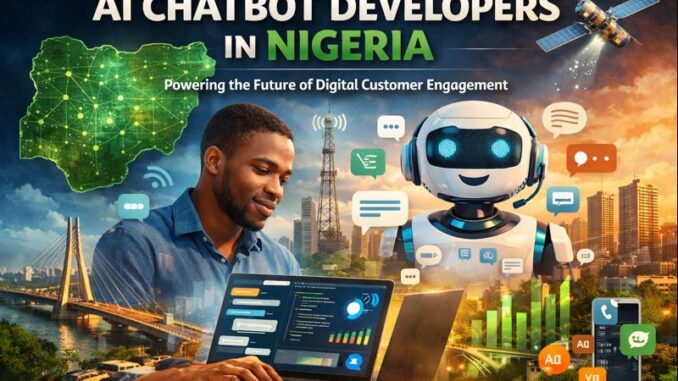
Nigeria’s digital economy is entering a decisive phase. As businesses compete for attention in a mobile-first, always-online market, customer engagement has become both a strategic advantage and an operational challenge. At the centre of this shift are AI chatbot developers in Nigeria, quietly building conversational systems that are transforming how organisations interact with customers, citizens, and users at scale.
What was once limited to basic automated replies has evolved into intelligent, context-aware digital assistants capable of handling customer support, sales, onboarding, data interpretation, and internal operations. This article provides a deep, practical analysis of the AI chatbot ecosystem in Nigeria—how it works, who is building it, why adoption is accelerating, and what the future holds.
What AI Chatbot Developers in Nigeria Actually Do
AI chatbot developers in Nigeria design, build, deploy, and maintain conversational systems that allow users to interact with businesses and institutions using natural language. These interactions occur across platforms such as WhatsApp, websites, mobile applications, and social messaging channels.
Unlike traditional rule-based bots that rely on fixed scripts, modern AI chatbots developed in Nigeria increasingly use:
- Natural Language Processing (NLP) to understand user intent
- Machine learning models to improve responses over time
- Large Language Models (LLMs) to generate human-like, context-aware replies
- Backend integrations with CRMs, payment systems, databases, and APIs
The role of the developer extends beyond coding. It includes conversation design, data training, security configuration, analytics setup, and ongoing optimisation based on real user behaviour.
Why AI Chatbots Are Gaining Rapid Adoption in Nigeria
1. Mobile-First Consumer Behaviour
Nigeria is fundamentally a mobile-driven market. Millions of users rely on smartphones as their primary access point to the internet. Messaging apps—particularly WhatsApp—have become the default communication channel for both personal and business interactions. AI chatbots fit naturally into this behaviour, allowing businesses to meet customers where they already are.
2. High Customer Demand, Limited Human Capacity
Many Nigerian businesses face high volumes of customer inquiries but cannot scale human support teams proportionally. AI chatbots provide a cost-effective way to handle repetitive queries instantly while reserving human agents for complex issues.
3. 24/7 Availability Without Operational Overhead
Unlike call centres, chatbots do not require shifts, overtime, or physical infrastructure. This is especially valuable in sectors such as fintech, telecoms, logistics, and e-commerce, where users expect real-time responses at any hour.
4. Data-Driven Decision Making
Every chatbot interaction generates structured data. Nigerian businesses are increasingly using chatbot analytics to understand customer pain points, frequently asked questions, drop-off points, and buying intent—insights that directly inform strategy.
Real-World AI Chatbot Deployments in Nigeria
MTN Nigeria’s Zigi Chatbot
MTN Nigeria’s Zigi chatbot is one of the most advanced enterprise chatbot deployments in the country. Integrated across WhatsApp, Telegram, Facebook Messenger, and web platforms, Zigi enables users to perform tasks such as checking balances, purchasing data, and resolving service issues without speaking to a human agent.
MTN’s deployment demonstrates how AI chatbots can operate as core digital infrastructure, not just support tools.
Source: MTN Nigeria official announcement
BudgIT’s Bimi Chatbot for Civic Transparency
BudgIT, a Nigerian civic technology organisation, introduced Bimi, an AI chatbot designed to help citizens access public finance and budget data through simple conversational queries. Instead of navigating complex spreadsheets or reports, users can ask questions in plain language and receive clear explanations.
This use case highlights a critical insight: AI chatbots are not limited to commerce. They can also improve transparency, civic engagement, and public understanding of complex information.
Source: The Cable Nigeria
RELATED:
AI Tools for Smarter Financial Planning 2026: Unlocking Autonomous Finance Solutions for Companies
How AI Agents Improve Business Workflows: Supercharge Your Small Business in 2026
Moniepoint’s “M” Informal Economy Chatbot
Moniepoint launched “M”, an AI chatbot focused on interpreting data related to Nigeria’s informal economy. Built using large language model technology, the chatbot allows users to explore economic insights, business trends, and financial data conversationally.
This marks a shift from transactional chatbots to knowledge-driven conversational systems that support research, policy, and entrepreneurship.
Source: Nairametrics
Core Technologies Behind Nigerian AI Chatbots
Natural Language Processing (NLP)
NLP enables chatbots to understand what users mean, not just what they type. This includes intent recognition, entity extraction, and contextual understanding. For Nigerian developers, NLP must account for informal language, abbreviations, and local expressions.
Large Language Models (LLMs)
LLMs allow chatbots to generate more natural, flexible responses and maintain conversational context across multiple messages. This is particularly important for advisory, support, and data interpretation use cases.
Backend and API Integrations
Most production chatbots are connected to business systems such as CRMs, payment gateways, inventory databases, and analytics tools. The value of a chatbot depends heavily on how well it integrates with these systems.
Continuous Learning and Analytics
Effective chatbot deployments include monitoring dashboards that track response accuracy, escalation rates, user satisfaction, and unresolved queries. Developers use this data to retrain models and refine conversation flows.
Key Business Use Cases for AI Chatbots in Nigeria
Customer Support Automation
Chatbots handle frequently asked questions, service requests, and account inquiries instantly. This reduces wait times, lowers support costs, and improves customer satisfaction.
Sales and Lead Qualification
AI chatbots engage website visitors and messaging app users, qualify leads, recommend products, and guide users toward conversion—all without human intervention.
Fintech and Financial Services
From onboarding and KYC guidance to transaction support and account queries, chatbots play a critical role in Nigeria’s fintech ecosystem.
Internal Operations
Many organisations deploy chatbots internally for HR support, IT help desks, and knowledge management, improving productivity and reducing internal friction.
How to Choose the Right AI Chatbot Developer in Nigeria
When evaluating chatbot developers, Nigerian businesses should focus on:
- Technical depth, not just templates
- Experience with WhatsApp and messaging platforms
- Customisation and scalability
- Security and data protection practices
- Post-deployment support and optimisation
A chatbot is not a one-time project. It is an evolving system that improves with data, feedback, and iteration.
Ethical, Legal, and Operational Considerations
Data Privacy and Security
Chatbots often process sensitive user information. Developers and businesses must comply with data protection regulations and implement secure data handling practices.
Transparency and Trust
Users should be aware when they are interacting with an AI system and have clear pathways to reach human support when needed.
Bias and Accuracy
Language models can reflect biases present in training data. Responsible developers actively monitor and correct for this to ensure fair and accurate responses.
The Future of AI Chatbot Development in Nigeria
The next phase of chatbot adoption in Nigeria will be shaped by:
- Deeper localisation, including local languages and cultural context
- Expansion into healthcare, education, and agriculture
- Hybrid human-AI support models
- Greater government and enterprise investment in AI skills
As AI infrastructure matures, chatbots will increasingly function as digital employees, handling complex workflows and decision support tasks.
Conclusion
AI chatbot developers in Nigeria are building more than automated replies—they are creating intelligent systems that redefine how organisations engage, serve, and understand their users. From telecom giants and fintech leaders to civic organisations and SMEs, conversational AI is becoming a foundational layer of Nigeria’s digital economy.
For businesses willing to invest strategically, AI chatbots offer measurable gains in efficiency, accessibility, and customer experience. For developers, the opportunity lies in building systems that are not only intelligent, but also ethical, secure, and deeply aligned with local realities.
See How to Explain Data Mesh to Non-Technical Stakeholders: A Business-First Playbook for Executives
Frequently Asked Questions (FAQs)
What do AI chatbot developers in Nigeria do?
AI chatbot developers in Nigeria build intelligent chatbots that automate conversations on WhatsApp, websites, and apps. They use natural language processing and AI models to handle customer support, sales, onboarding, and data queries while integrating with business systems.
How much does an AI chatbot cost in Nigeria?
AI chatbot development in Nigeria typically costs between ₦150,000 and ₦3,000,000. Pricing depends on features such as WhatsApp integration, AI intelligence level, backend integrations, analytics, and ongoing support.
Are WhatsApp chatbots widely used in Nigeria?
Yes. WhatsApp chatbots are widely used in Nigeria because WhatsApp is the most popular messaging platform. Businesses use them for customer support, lead generation, order tracking, and payment reminders.
Which companies use AI chatbots in Nigeria?
Telecoms, fintechs, e-commerce platforms, logistics companies, and government organisations in Nigeria actively use AI chatbots to manage high customer interaction volumes and provide 24/7 service.
Can AI chatbots replace human customer service?
AI chatbots do not fully replace human agents. They handle repetitive questions and routine tasks, while complex or sensitive issues are escalated to human support teams.
Do AI chatbots in Nigeria support local languages?
Most AI chatbots in Nigeria primarily support English, but some developers are adding Nigerian English and local language capabilities. Localisation is expanding as adoption increases.
Are AI chatbots safe for customer data?
AI chatbots can be secure when built correctly. Reputable developers use encryption, access controls, and secure integrations to protect customer data and reduce privacy risks.
How long does it take to build an AI chatbot in Nigeria?
A basic AI chatbot can be developed in 2–4 weeks, while advanced chatbots with AI training and system integrations usually take 6–12 weeks or longer.
What platforms can AI chatbots be deployed on in Nigeria?
AI chatbots in Nigeria can be deployed on WhatsApp, websites, mobile apps, Telegram, Facebook Messenger, and internal business systems.
Is AI chatbot development growing in Nigeria?
Ready to Build or Deploy an AI Chatbot in Nigeria?
AI chatbots are no longer optional for businesses that want to scale customer engagement, reduce support costs, and stay competitive in Nigeria’s digital economy. Whether you are exploring WhatsApp automation, customer support chatbots, or AI-powered sales assistants, the right strategy starts with informed decisions.
Explore more in-depth guides on:
- WhatsApp Business automation in Nigeria
- AI tools for Nigerian businesses
- CRM and customer engagement automation

Leave a Reply