
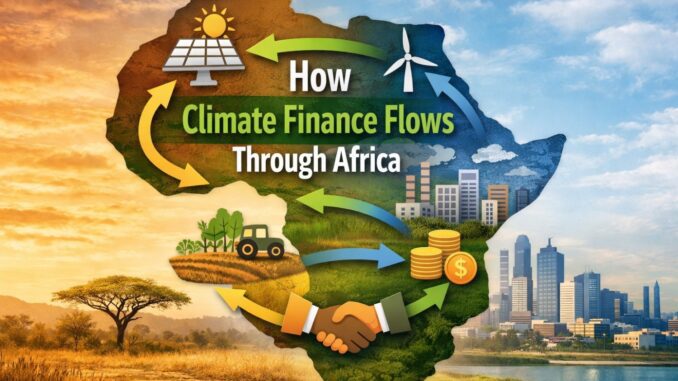
Understanding Africa’s Climate Finance Landscape
Climate finance is critical to Africa’s sustainable development and resilience against climate change. While Africa contributes minimally to global emissions, it faces disproportionate climate risks—including flooding, droughts, heat stress, and food insecurity. Despite global growth in climate finance, Africa still faces a significant gap between available funding and its adaptation and mitigation needs. Recent inflows are dominated by multilateral development banks (MDBs) and public concessional finance, but funding is uneven across countries and sectors.
This article provides a data-driven, and analytical insight into how climate finance flows through Africa, covering sources, instruments, sectoral and geographic distribution, bottlenecks, country case studies, and actionable recommendations.
1. Overview: How Climate Finance Supports Africa’s Growth and Resilience
Climate finance refers to financial resources mobilized to mitigate climate change and adapt to its impacts. Key components include:
- Mitigation finance: Investments in renewable energy, low-carbon infrastructure, and energy efficiency.
- Adaptation finance: Investments in climate-resilient agriculture, water resource management, coastal protection, and disaster risk reduction.
- Instruments: Grants, concessional loans, commercial loans, equity, guarantees, insurance, and blended finance.
According to the Climate Policy Initiative (2024), Africa received approximately $43–44 billion in climate finance in 2021/22, up 48% from 2019/20. However, annual adaptation and mitigation needs for Africa exceed hundreds of billions of dollars (CPI, 2024; World Bank, 2024).
2. Key Sources of Climate Finance Flowing Into Africa
2.1 Multilateral Development Banks: Anchors of Africa’s Climate Investment
MDBs, including the World Bank Group and African Development Bank (AfDB), are the dominant providers of climate finance. Their contributions include:
- Concessional and non-concessional loans
- Grants
- Guarantees and blended finance instruments
- Technical assistance
These institutions also catalyze private investment by reducing project risks and enhancing credibility.
2.2 Bilateral Donors: Strategic Adaptation Support
Countries such as Germany, France, the UK, and the USA channel bilateral climate finance to Africa. These flows often emphasize adaptation and capacity building, especially in fragile and low-income countries (OECD, 2023).
2.3 Dedicated Climate Funds: Bridging the Adaptation Gap
Funds such as the Green Climate Fund (GCF), Climate Investment Funds (CIF), and the Adaptation Fund provide concessional finance for high-impact, non-commercial projects (UNEP, 2023).
2.4 Private Sector Investors: Unlocking Mitigation Potential
Private investment remains concentrated in mitigation sectors like renewable energy. Mobilization of private capital in adaptation is limited due to perceived high risk and uncertain revenue streams (World Bank, 2024).
2.5 Domestic Public Finance: Ensuring Ownership and Local Currency Solutions
National governments contribute through budgets, state-owned enterprises, and sovereign borrowing. Fiscal constraints and high debt service costs limit the scale of domestic climate investment (AfDB, 2024).
RELATED: Tracking the Numbers: Understanding Nigeria 2026–2028 MTEF/FSP for Smarter Economic Decisions
3. How Climate Finance Moves Through African Economies
| Flow Stage | Description | Key Actors |
|---|---|---|
| Capital Origination | Funding sources for climate projects | MDBs, bilateral donors, climate funds, private investors, domestic public finance |
| Intermediation | Channels and mechanisms for deployment | MDBs, national development banks, commercial banks, DFIs |
| Deployment | Implementation of climate projects | PPPs, government programs, project finance structures |
| Monitoring & Reporting | Tracking outcomes and finance utilization | OECD-DAC, MDB disclosures, national registries |
Climate finance originates from donors, MDBs, climate funds, and institutional investors.
3.2 Intermediation: Channels and Mechanisms
Funds are intermediated through:
- MDBs
- Development finance institutions
- National development banks
- Commercial banks
3.3 Deployment: Project Execution and Delivery
Deployment occurs via:
- Project finance structures
- Public-private partnerships (PPPs)
- Government programs
3.4 Monitoring and Reporting: Transparency and Accountability
Project outcomes and fund utilization are tracked using OECD-DAC, MDB disclosures, and national registries.
RELATED: Debt Financing Nigerian Firms: Emerging Trends, Hidden Risks, and Untapped Growth Opportunities
4. Sectoral Distribution: Where Climate Finance Goes in Africa
4.1 Mitigation-Focused Sectors: Driving Decarbonization
- Renewable energy (solar, wind, hydro, geothermal)
- Energy efficiency programs
- Low-carbon transport
- Industrial decarbonization
Mitigation receives more funding due to predictable revenue streams that are favorable to both private and public investors.
4.2 Adaptation and Resilience: Closing the Gap
- Climate-smart agriculture
- Water management and flood control
- Coastal protection
- Nature-based solutions
Adaptation remains underfunded despite high social and economic returns, reflecting a structural market failure (UNEP, 2023).
5. Geographic Distribution: Addressing Concentration Risk
Finance is concentrated in countries with stronger institutions, stable policies, and clearer project pipelines, such as South Africa, Morocco, Kenya, and Egypt. Vulnerable low-income states, especially in the Sahel and island nations, remain underfunded (CPI, 2024), highlighting systemic risk.
6. Country Spotlight: Nigeria’s Climate Finance Landscape
6.1 Climate Risk Profile and Economic Exposure
Nigeria faces adaptation challenges including flooding, desertification, and coastal erosion. Agriculture, infrastructure, and energy are particularly vulnerable. Climate shocks impact GDP, inflation, and public debt (World Bank, 2024).
6.2 Climate Finance Channels
- MDBs (World Bank, AfDB)
- Bilateral donors
- Climate funds
- Private sector (mainly renewable energy)
Adaptation finance is mostly grant-funded, while mitigation projects attract both public and private investment.
6.3 Sectoral Allocation
Mitigation: Renewable energy, power transmission, and energy efficiency.
Adaptation: Flood control, climate-smart agriculture, and water management.
6.4 Structural Constraints
- Currency volatility and regulatory uncertainty
- Weak subnational project preparation
- Heavy reliance on debt instruments
6.5 Strategic Opportunities
- Establish national project preparation facilities
- Scale local-currency finance instruments
- Expand guarantee-based risk mitigation
- Integrate climate priorities into fiscal frameworks
- Strengthen data and reporting
Sources: World Bank (2024), AfDB (2024), UNEP (2023), CPI (2024)
7. Africa-Wide Data Analysis: Trends and Insights
7.1 Public vs Private Split
- Public and concessional: ~80–85%
- Private: ~15–20%
7.2 Sectoral Allocation (Indicative)
| Sector | Share | Risk |
|---|---|---|
| Renewable Energy | High | Medium |
| Transport | Medium | Medium |
| Agriculture (Adaptation) | Low | High |
| Water & Resilience | Low | High |
| Industry | Medium | Medium |
7.3 Concentration Risk
Most finance flows to a few countries, leaving fragile states underfunded (CPI, 2024).
8. Key Bottlenecks Limiting Climate Finance Flows
- Bankability and project preparation gaps
- High cost of capital due to perceived risks
- Limited domestic capital markets
- Instrument mismatch, especially for adaptation
- Fragmented reporting and data gaps
9. Policy and Investment Recommendations for Africa
- Strengthen national project pipelines
- Scale blended finance and guarantees
- Increase grant-based adaptation finance
- Develop local capital markets and financial systems
- Standardize project documentation and contracts
- Embed climate finance in fiscal and development plans
- Improve climate finance tracking and transparency
Sources: OECD (2023), UNEP (2023), CPI (2024), AfDB (2024)
READ ALSO: Newtek Small Business Finance: Strategic Capital Solutions for Sustainable Growth in 2026
10. Investor Perspective: Unlocking Opportunities in Africa
Africa presents a high-risk, high-opportunity climate investment landscape. Strategic use of public capital can catalyze private flows via guarantees, first-loss facilities, and blended finance. Mitigation projects offer competitive risk-adjusted returns, while adaptation requires innovative instruments to attract investors.
Conclusion
How climate finance flows through Africa depends on institutional capacity, financial instruments, and policy frameworks. While inflows are growing, structural inefficiencies persist, particularly for adaptation projects and vulnerable countries. Many adaptation initiatives remain underfunded, while mitigation projects receive a disproportionate share of finance. Concentration of funds in a few countries leaves the most climate-sensitive regions underprotected.
To transform climate finance into a true catalyst for growth, Africa must strengthen project pipelines, improve regulatory frameworks, enhance transparency, and strategically deploy blended finance to mobilize private investment. Aligning climate finance with national and regional development priorities, integrating local stakeholders, and ensuring equitable allocation can maximize social, environmental, and economic impacts. With these targeted reforms and coordinated international support, Africa can bridge the climate finance gap, scale mitigation and adaptation efforts effectively, and foster resilience, inclusive growth, and sustainable development.
FAQs: Analytical and Engaging
Q1: How much climate finance does Africa receive annually?
A: Approximately $43–44 billion in 2021/22 (CPI, 2024), below projected needs.
Q2: Which sectors attract the most climate finance?
A: Renewable energy, low-carbon transport, and industrial efficiency.
Q3: Why is adaptation underfunded?
A: Low revenue generation and high risk limit private investment.
Q4: How can private finance be mobilized?
A: Through de-risking instruments, blended finance, and standardized project pipelines.
Q5: Which countries receive the most climate finance?
A: South Africa, Morocco, Kenya, and Egypt.
Q6: What is the adaptation finance gap?
A: Estimated at hundreds of billions annually by 2030 (UNEP, 2023).
Q7: What is the role of domestic finance?
A: Provides ownership and local currency solutions, but fiscal constraints limit scale.
Q8: Can climate finance reduce debt stress?
A: Grants and concessional finance can, but debt-financed projects without revenue may worsen debt.
Q9: How can countries improve finance absorption?
A: Strengthen project preparation, regulatory frameworks, and transparency.
Q10: What instruments attract private investors?
A: Guarantees, first-loss facilities, and blended finance structures.

Leave a Reply