
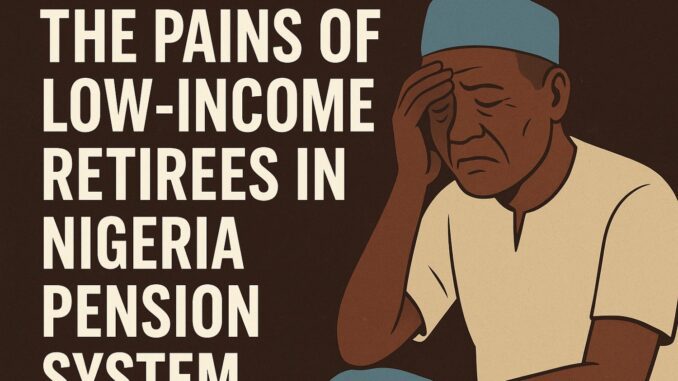
Introduction: When Service Ends and Suffering Begins
Retirement should be a peaceful reward for decades of labour. Yet across Nigeria, countless low-income retirees live on the edge of survival.
After years of working as civil servants, teachers, cleaners, or clerks, many now face a bitter truth: the pension they waited for cannot even buy a month’s groceries.
Queues at pension verification centres stretch for hours; some retirees faint under the sun, others die waiting for “gratuities” that never arrive. These are not exaggerated stories — they are the real experiences of people who once helped build the nation.
The pains of low-income retirees in Nigeria pension system are a mirror reflecting the failures of governance, economic instability, and poor social policy. Behind every unpaid pension lies a human tragedy — one that Nigeria continues to ignore.
How the Pains of Low-Income Retirees in Nigeria Pension System Became a National Emergency
A Crisis Decades in the Making
Nigeria’s pension challenges didn’t begin overnight. For decades, pension management was poorly structured, largely dependent on government subventions with little accountability.
The old Defined Benefit System (DBS) meant the government paid retirees directly. But by the late 1990s, records were in shambles, corruption was rampant, and arrears ran into hundreds of billions of naira.
When the Pension Reform Act of 2004 introduced the Contributory Pension Scheme (CPS), expectations soared. It was meant to create transparency and sustainability through employer–employee contributions managed by Pension Fund Administrators (PFAs).
Yet, 20 years later, many retirees still face the same issues — delayed payments, lost records, and unpaid contributions. What went wrong?
The Disconnect Between Policy and Practice
The CPS was modeled after successful systems in Chile and Malaysia, but Nigeria’s weak enforcement diluted its promise.
Some state governments joined late; others still operate the old scheme. Employers in the public and private sectors often fail to remit contributions promptly, while PenCom’s oversight struggles with bureaucracy and political interference.
Consequently, thousands of retirees who contributed faithfully find little waiting for them at the end of their careers.
This disconnect between policy and reality is the foundation of the pains of low-income retirees in Nigeria pension system today.
The Financial Struggle — Inflation, Delays, and Diminishing Value
Inflation’s Merciless Grip on Pensioners
Nigeria’s inflation, which hit over 30% in 2025 (NBS), has wiped out the real value of pensions.
A retiree receiving ₦30,000 monthly today effectively earns less than ₦10,000 in 2015 terms. Rent, food, and healthcare costs have tripled, but pensions have not been adjusted accordingly.
For a retired cleaner or primary school teacher, that means choosing between food and medication. Even those with modest savings find them quickly consumed by inflationary pressure.
Many retirees now depend on their children, most of whom are unemployed or underemployed — perpetuating a painful cycle of intergenerational poverty.
The Hidden Cost of Payment Delays
Beyond inflation, many states and federal agencies delay pension payments for months.
Investigations by civil society groups (BudgIT, 2024) found that pension disbursements are often delayed due to budget bottlenecks and corruption.
In some cases, retirees have to pay bribes to “facilitate” the release of their entitlements.
For pensioners who rely solely on these payments, even a one-month delay can mean starvation. These chronic delays make the pains of low-income retirees in Nigeria pension system not just financial, but existential.
The Emotional and Social Impact of Retirement Poverty
Depression, Loneliness, and Loss of Purpose
Retirement should bring rest, but for many Nigerians it brings despair. Psychologists describe a phenomenon called post-retirement identity loss, where retirees feel worthless and forgotten.
The Nigerian Psychological Association (2023) reported that depression among retirees rose by 40% over the past five years, largely due to economic hardship and social neglect.
Mrs. Adetola, a retired nurse in Ibadan, explained:
“I gave 35 years of my life to public service. Now I can’t even afford the drugs I used to administer to patients. It’s humiliating.”
This emotional burden reveals a deeper truth — Nigeria has failed to build a social system that values the elderly.
Family Dependence and the Burden of Survival
Retirees without savings often depend on children or relatives. In many cases, families already battling unemployment must stretch resources to feed aging parents.
A 2025 survey by SBM Intelligence found that three out of five urban households support at least one retiree financially.
This dependence erodes the retirees’ dignity and increases household poverty.
The traditional family safety net that once protected elders is collapsing under economic hardship, leaving retirees vulnerable and invisible.
The Dark Underbelly — Corruption and Bureaucratic Rot
Scandals that Eroded Trust
The pension sector has witnessed multiple high-profile corruption scandals.
From the Police Pension Fund embezzlement to the Maina saga, billions meant for pensioners vanished through fraud and ghost workers.
According to the Economic and Financial Crimes Commission (EFCC), over ₦70 billion in pension fraud cases were recorded between 2010 and 2024.
Such cases destroyed public trust and reinforced the feeling that pension funds are “lootable assets” rather than sacred savings.
These scandals are why the pains of low-income retirees in Nigeria pension system persist — corruption steals not just money, but hope.
Endless Verification and Lost Records
Every few months, retirees are called for “biometric verification.” In theory, this prevents ghost pensioners. In reality, it punishes the living.
Elderly men and women queue under harsh weather for hours, only to be told their files are missing or incomplete. Some collapse from exhaustion; others never return.
Despite attempts by PenCom and PTAD (Pension Transitional Arrangement Directorate) to digitalize processes, manual verification remains common, especially in rural areas.
The result is inefficiency, trauma, and wasted lives.
Comparing Systems — Lessons from Other Nations
Ghana, South Africa, and the UK Offer Lessons
Ghana’s pension scheme, though smaller, includes inflation-indexed adjustments and a simplified payment structure. Retirees receive benefits via bank transfers or mobile money — reducing bureaucracy.
South Africa’s Old Age Grant guarantees every citizen above 60 a monthly stipend, ensuring no senior citizen falls below the poverty line.
In the United Kingdom, the triple lock system guarantees yearly pension increases tied to inflation or wage growth.
Nigeria lacks all these safeguards. The absence of inflation adjustment or universal coverage has left millions exposed to hardship. If Nigeria implemented even one of these models, the pains of low-income retirees in Nigeria pension system would reduce significantly.
The Health Dimension — When Illness Meets Poverty
Retirees Without Medical Security
Healthcare is one of the largest expenses retirees face. Yet, most Nigerian retirees are excluded from the National Health Insurance Authority (NHIA) after leaving service.
This means retirees must pay out-of-pocket for medical treatment. Chronic illnesses like hypertension and diabetes become financial death sentences.
A 2024 study by the Nigerian Medical Journal found that 78% of retirees self-medicate or abandon treatment due to cost.
The government’s promise of free healthcare for elderly citizens remains largely unimplemented.
When pensions can’t pay for medicine, every ailment becomes a crisis — a painful metaphor for growing old in Nigeria.
The Social Cost of Neglect
The health of retirees directly affects national wellbeing. When retirees fall ill and die prematurely, decades of experience and mentorship are lost.
Economists estimate that Nigeria loses millions yearly in potential value from early retiree deaths — wisdom that could have guided younger workers and strengthened institutions.
Addressing the pains of low-income retirees in Nigeria pension system is, therefore, not just moral; it’s economic common sense.
The Role of PenCom and PFAs — Progress and Pitfalls
What PenCom Has Done Right
To its credit, PenCom has introduced initiatives such as online verification, the micro-pension scheme for informal workers, and tighter regulation of PFAs.
As of 2025, the pension fund assets exceeded ₦18 trillion, showing that the contributory system can generate wealth when properly managed.
However, the benefits of these funds rarely trickle down to the poorest retirees. Many of them retired before 2004 and are still trapped under the old scheme, waiting for gratuities from insolvent state governments.
The Communication Gap
Many retirees lack a clear understanding of how the pension system works.
Some do not know their PFAs, their contribution balances, or the procedures for withdrawal. This knowledge gap leads to exploitation and frustration.
PenCom must do more than regulate; it must educate — ensuring that every worker understands how to safeguard their retirement.
A well-informed retiree is less likely to be victimized by inefficiency.
Policy Pathways — What Can Be Done Now
Short-Term Reforms
- Immediate Audit of Pension Arrears:
Federal and state governments should publish arrear data and timelines for full payment. Transparency breeds accountability. - Inflation-Linked Adjustment:
Pension payments must rise automatically with inflation to protect retirees’ purchasing power. - E-Verification and Mobile Payments:
Replace physical verification with biometric apps linked to BVN and NIN databases. - Retiree Welfare Grants:
Establish a minimum ₦10,000 monthly grant for pensioners earning below ₦30,000.
Long-Term Structural Reforms
- Strengthen Enforcement:
Employers that fail to remit contributions should face stiff penalties, including suspension from government contracts. - Integrate Informal Sector Workers:
The micro-pension initiative must be aggressively expanded to artisans, traders, and farmers — the largest group outside formal pensions. - Digital Transparency:
Launch a public pension dashboard showing contributions, arrears, and disbursements in real time. - National Elderly Care Policy:
Implement comprehensive support covering healthcare, housing, and welfare for retirees.
Expert Opinions and Economic Insights
Economists Warn of Looming Social Crisis
According to Dr. Aisha Bello, a development economist at the University of Lagos,
“When over half of a country’s elderly live in poverty, you’re not just facing an economic issue — you’re facing a moral collapse. The pension system must become a national priority.”
Analyst Rotimi Ogunleye adds that the problem is less about funding and more about political will. Nigeria can afford pensions, but corruption and mismanagement divert resources.
Civil Society Demands Accountability
Groups like BudgIT, SERAP, and the Nigeria Union of Pensioners (NUP) have repeatedly called for open publication of pension remittances.
Their advocacy has exposed hidden arrears in many states and pushed for greater transparency.
However, most reforms end up trapped in bureaucracy — promises made during elections, forgotten afterward.
Until advocacy translates into action, the pains of low-income retirees in Nigeria pension system will continue to haunt the nation’s conscience.
The Broader Economic Picture — Why Pension Reform Matters
Building Trust in Institutions
A functioning pension system is more than just a payment mechanism; it’s a symbol of trust between citizens and government.
When workers see that retirees are treated fairly, they’re more motivated to serve diligently and contribute honestly.
Failure to reform pensions weakens morale and deepens corruption, as workers try to “secure their future” through shortcuts before retirement.
RELATED:
Food Inflation in Rural Nigeria Rises as Farmers Chase Urban Profits
Can Nigeria Sustain Economic Growth Under Rising Insecurity?
MPOWER Financing Nigeria: The Ultimate Guide for 2025 Students
Driving Economic Stability
Properly managed pension funds are powerful investment tools. They can finance infrastructure, agriculture, and technology projects while generating returns for retirees.
Countries like Chile and Singapore built parts of their development on pension savings.
Nigeria already holds trillions in pension assets. With transparency and discipline, these funds could fuel national growth — turning pain into prosperity.
The Human Face of Numbers — Real Stories, Real Lessons
Mr. Okoro’s Journey
After 33 years as a government driver, Mr. Okoro retired in 2018. He expected a pension within six months. Seven years later, he still hasn’t received his gratuity.
“I live on small jobs washing cars for my neighbours. I never thought old age would be like this,” he said.
His story represents millions like him — loyal, disciplined workers whose lives ended in poverty due to administrative neglect.
Mrs. Yusuf’s Struggle
A retired primary school teacher from Kano, Mrs. Yusuf receives ₦18,000 monthly.
With inflation, that amount can barely cover food for two weeks. Her children send money occasionally, but she often skips meals to afford her medication.
She concluded bitterly, “If this is what service to Nigeria brings, then what was the point?”
The Path Forward — Restoring Dignity and Justice
Towards a Compassionate Pension Future
The pains of low-income retirees in Nigeria pension system can no longer be ignored.
Government must recognize pension reform as both an economic and human rights issue.
Timely payments, inflation protection, healthcare access, and digital transparency are not luxuries — they are necessities.
A Call to Conscience
A nation is judged by how it treats its elderly.
If Nigeria continues to neglect its retirees, it sends a chilling message to those still working: “You’re on your own.”
Fixing the pension system is not just about money — it’s about restoring trust, dignity, and justice.
Conclusion: The Final Years Shouldn’t Be the Hardest
Retirees built Nigeria’s schools, hospitals, and institutions. They deserve gratitude, not neglect.
As the sun sets on their working lives, it should rise in comfort, not despair.
The time for half measures is over.
A fair, transparent, and compassionate pension system is not a dream — it’s a duty.
And until that duty is fulfilled, the pains of low-income retirees in Nigeria pension system will remain one of the country’s deepest wounds.

Leave a Reply