
Nigeria’s Inflation Finally Shows Relief — The Turning Point of 2025
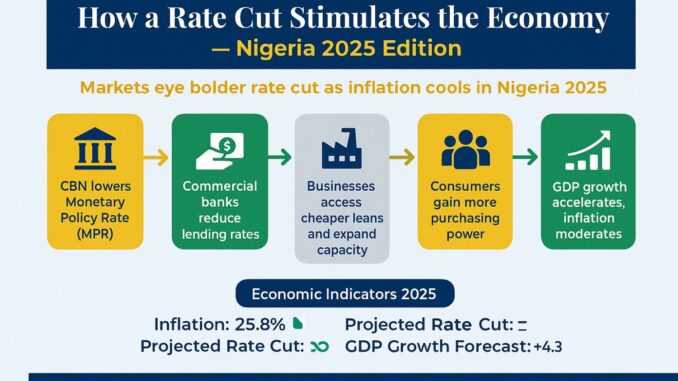
Nigeria entered 2025 with a long-awaited sense of economic relief. After two years of unrelenting price pressures, food inflation crises, and currency instability, the tide has begun to turn. The National Bureau of Statistics (NBS) reported a consistent slowdown in the inflation rate — down from 31.7% in January to 25.8% by September 2025.
This easing trend has ignited cautious optimism. For many businesses and consumers, it’s a sign that the worst of Nigeria’s inflation wave may finally be behind.
At the heart of this change lies the Central Bank of Nigeria (CBN)’s aggressive monetary tightening policies of 2023–2024. Having raised the Monetary Policy Rate (MPR) several times to above 26%, the CBN successfully cooled speculative demand for foreign exchange and stabilized core inflation. Now, with inflation easing, markets are eyeing a bolder rate cut in late 2025 — one that could stimulate investment, restore credit flow, and reawaken Nigeria’s real economy.
Why Markets Eye a Bolder Rate Cut as Inflation Cools in Nigeria 2025
The phrase “Markets eye bolder rate cut as inflation cools in Nigeria 2025” is more than just a headline; it represents a pivotal shift in investor psychology.
Investors, both domestic and foreign, are watching how the CBN navigates the balance between economic recovery and inflation management. The current MPR of 26% has been effective in taming inflation, but it has also stifled private sector borrowing, especially among small and medium enterprises (SMEs).
A rate cut of even 200 basis points could unleash a wave of optimism across the financial ecosystem — reducing borrowing costs, improving liquidity, and signaling that Nigeria is entering a new phase of stability.
Banks are preparing for it. The stock market is anticipating it. Businesses are longing for it. And the CBN, under increasing pressure to support real sector growth, may not delay much longer.
The Economic Context — Reforms, Risks, and Realities
The inflation slowdown isn’t happening in isolation. It reflects a broader reform agenda championed by the Tinubu administration.
Fuel Subsidy Removal and Fiscal Discipline
The fuel subsidy removal of 2023 was painful but necessary. It freed up nearly ₦7 trillion in annual expenditure, allowing the government to redirect funds to capital projects and infrastructure.
Exchange Rate Unification
The decision to merge multiple exchange rates under the Investors and Exporters (I&E) window reduced arbitrage opportunities and stabilized foreign inflows.
Debt Restructuring and Fiscal Realignment
Nigeria’s debt-service-to-revenue ratio fell slightly from 83% in 2023 to 68% in 2025, a sign that fiscal measures are starting to yield results.
Digital Revenue Mobilization
The government’s adoption of digital tax systems and electronic revenue collection has improved transparency and reduced leakages.
All these measures, collectively, have built the foundation for a more stable macroeconomic environment — giving the Central Bank room to ease interest rates without reigniting inflation.
Business Impact — How a Rate Cut Could Transform the Private Sector
A bolder rate cut would have far-reaching implications for Nigeria’s business landscape.
1. SMEs Could Breathe Again
Small businesses have borne the brunt of high lending costs. Many faced interest rates of 28–32%, forcing them to scale down operations. A rate cut would revive lending, enabling SMEs to expand, hire, and invest in productivity.
2. Manufacturing Rebound
Manufacturers, especially in consumer goods, have struggled with high input costs and limited credit. Lower rates would reduce financing burdens, increase output, and help stabilize prices for local goods.
3. Real Estate and Construction Revival
The real estate sector — one of the hardest hit by tight liquidity — could see new investments in housing, logistics, and infrastructure as financing becomes more affordable.
4. Banking and Stock Market Boost
Banks stand to benefit from increased lending volumes, while the Nigerian Exchange (NGX) could rally as investors reprice stocks in anticipation of stronger growth.
5. Consumer Spending Recovery
With improved credit availability, households could regain purchasing power, stimulating retail and service industries.
Investor Sentiment — The Return of Confidence
The focus keyword — markets eye bolder rate cut as inflation cools in Nigeria 2025 and what it means for investors — captures a critical psychological moment: the return of confidence.
Global investment firms, such as JP Morgan and Fidelity Africa, have begun revising their outlook for Nigeria from “cautiously bearish” to “neutral-positive.”
Portfolio inflows into Nigerian bonds and equities have increased by 14% in Q3 2025 compared to the previous year. Analysts attribute this to a combination of improved policy direction, consistent monetary communication, and macroeconomic stabilization.
“The market is reacting to signals that Nigeria is past its peak inflation period,” says Chike Onwualu, Head of Strategy at Sterling Asset Management.
“If the Central Bank executes a responsible rate cut, it could mark the beginning of a multi-year growth cycle.”
Global Context — Lessons from Other Emerging Markets
Nigeria’s potential rate cut comes at a time when other emerging markets are also shifting toward easing cycles.
- Brazil, after years of double-digit inflation, has cut rates steadily since mid-2024 and has seen improved business confidence.
- South Africa is signaling its own rate cut in Q1 2026, following a similar inflation decline.
- India continues to maintain a growth-first policy stance with moderate inflation control.
These global patterns indicate that Nigeria’s move would align it with broader emerging market trends — signaling maturity and economic normalization after years of volatility.
READ ALSO:
2025 Capital Gains Tax: Small Investors Protected, High Earners Targeted
Nigerian Banks Tapping Solar Energy to Cut Rising Diesel Costs — Economic Modeling & ROI Breakdown
Challenges Still Looming
Despite the optimism, Nigeria’s economic recovery remains fragile.
- Exchange Rate Volatility — The naira, while relatively stable, remains vulnerable to oil price swings and speculative pressures.
- Fiscal Constraints — Public debt remains high, and government revenue diversification is still limited.
- Infrastructure Deficit — Without aggressive investment, productivity gains from rate cuts could be muted.
- Political Uncertainty — Policy continuity is crucial for investor confidence beyond 2025.
For Nigeria, managing these risks while delivering growth will require coordinated fiscal and monetary discipline.
The Human Side — Inflation, Income, and Hope
Beneath the macroeconomic jargon lies the everyday Nigerian.
When inflation cools, prices at markets and transport terminals tell the real story. A bag of rice that once sold for ₦60,000 now averages ₦48,000. Transport fares have dropped slightly in major cities, and power supply improvements have reduced generator costs.
Households are beginning to feel a slow but real relief.
If a rate cut spurs more business activity, it could translate into new jobs, more credit, and a better standard of living. For millions, it’s not just economic policy — it’s personal survival.
2026 Outlook — The Path to Sustainable Recovery
Analysts predict that by mid-2026, Nigeria’s inflation could drop below 20% if current trends hold.
If the CBN cuts rates strategically, GDP growth could accelerate from 2.9% in 2024 to over 4.3% in 2026.
Sectors likely to lead the rebound include:
- Agriculture (boosted by cheaper financing)
- Technology and Fintech (driven by investor re-entry)
- Manufacturing (supported by improved logistics and consumer demand)
- Banking (expanded credit portfolios and digital lending growth)
This would place Nigeria back among Africa’s fastest-growing economies — and position it as a key driver of the continent’s next economic wave.
Expert Forecasts — The New Nigeria Monetary Narrative
“Nigeria has a chance to rewrite its economic narrative,” says Dr. Bode Alabi, economist at Lagos Business School.
“If reforms stay consistent and inflation continues to ease, 2025 could be remembered as the year Nigeria found its economic rhythm again.”
“We expect a 200–300 basis point rate cut before Q2 2026,” notes Goldman Capital Africa in its October 2025 macro update.
“That would mark the beginning of a recovery-led monetary cycle that favors growth and equity performance.”
Conclusion — The New Dawn for Nigeria’s Economy
The story of Markets eye bolder rate cut as inflation cools in Nigeria 2025 and what it means for businesses, growth, and investors is ultimately a story of resilience and renewal.
After years of inflationary shocks, Nigeria is finally finding a balance between price stability and growth. A bold yet responsible rate cut could ignite a new wave of investment, confidence, and productivity — setting the stage for the nation’s economic revival through 2026 and beyond.
For policymakers, the message is clear: stay disciplined, communicate clearly, and ensure that reforms reach ordinary Nigerians. For investors, the opportunity is equally clear — Nigeria is recalibrating, and those who read the signals early stand to gain the most.

Leave a Reply