
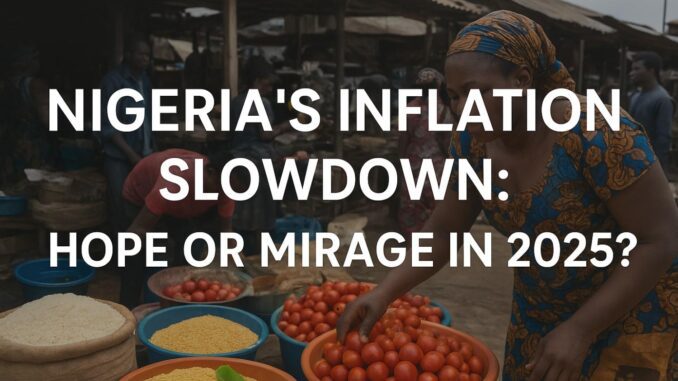
For months, Nigerians have been told that the country’s inflation rate is slowing. Government officials, policymakers, and some economic analysts have described this as a signal of “better days ahead.” Yet, for the average Nigerian, whose pockets are shrinking while prices remain painfully high, the optimism is hard to believe.
This paradox—between statistical improvement and lived reality—is not unique to Nigeria. Around the world, nations struggling with inflation face similar skepticism among their citizens. But Nigeria’s case carries a unique complexity, given its fragile economy, reliance on imports, volatile currency, and deep social inequalities.
This article explores whether slower inflation in Nigeria truly signals relief, or if it is simply a mirage. We’ll dig into global perspectives, Nigeria’s economic history, everyday examples, and what the future might hold.
1. Understanding Inflation Beyond the Headlines
Inflation, at its simplest, refers to the general rise in prices over time. But behind this textbook definition lies a web of realities: shrinking purchasing power, wage stagnation, and inequality.
When Nigerian authorities announce that inflation has “slowed,” what they really mean is that the rate at which prices are rising has decreased—not that prices themselves are falling.
- If inflation drops from 34% to 30%, it means prices are still climbing, just not as fast.
- For a market woman in Lagos who buys rice today, the bag might cost ₦55,000 instead of ₦57,000 last month. Yes, the increase is smaller, but affordability remains a struggle.
This difference between slower inflation and lower prices is at the heart of Nigerians’ doubts.
2. Nigeria’s Inflation Story: A Long Struggle
Nigeria’s inflation problem is not new. Since the 1980s, structural weaknesses in the economy have kept prices unstable.
- 1980s–1990s: Structural Adjustment Programs (SAP) led to currency devaluations, triggering price spikes.
- 2000s: Oil booms cushioned inflation temporarily, but dependence on imports kept vulnerabilities alive.
- 2020s: COVID-19, global supply chain disruptions, and Russia-Ukraine war worsened food and fuel inflation.
By 2023, inflation hit record highs of over 33%, with food inflation crossing 40%—one of the highest in the world. The average Nigerian family could no longer rely on staples like rice, garri, or yam without feeling financial strain.
So, when government agencies report “a slowdown,” Nigerians naturally question: How does this help me buy bread, transport my children to school, or refill cooking gas?
3. Global Context: Inflation Everywhere, Doubts Everywhere
Nigeria is not alone in facing citizen skepticism about inflation reports.
- United States: Inflation peaked at 9.1% in 2022, the highest in 40 years. By mid-2023, it slowed to around 4%. Yet, many Americans still felt poorer because prices never returned to pre-2021 levels.
- United Kingdom: UK inflation slowed from 11.1% (2022) to below 5% in 2024. But housing costs, groceries, and energy bills remained painfully high.
- Argentina: Inflation above 200% in 2023 meant that even when “slowing,” citizens still struggled with affordability.
This pattern reveals a global truth: slowing inflation rarely feels like relief on the ground because people live with absolute prices, not statistical percentages.
4. Why Nigerians Doubt the Gains
a) Currency Instability
The naira has suffered repeated devaluations, most recently after the government floated the currency in 2023. Even with slower inflation, exchange rate volatility continues to push up import costs.
b) Food Prices
Food accounts for more than 50% of household spending in Nigeria. Even a slight increase can devastate families. The World Bank noted in 2024 that Nigeria’s food inflation is among the highest in Sub-Saharan Africa.
c) Energy and Transport Costs
Fuel subsidy removal in 2023 led to a sharp increase in petrol prices, which cascaded into transportation and food distribution costs. Citizens feel this daily, regardless of inflation statistics.
d) Trust Deficit
There’s a gap between what policymakers say and what ordinary Nigerians experience. Years of unmet promises have created skepticism toward official data.
5. Case Studies: Everyday Nigerian Experiences
- Chioma, a Teacher in Enugu: Her monthly salary of ₦80,000 barely covers rent and groceries. Even though inflation “slowed,” her food basket costs nearly 50% more than a year ago.
- Ahmed, a Taxi Driver in Kano: Petrol prices doubled after subsidy removal. Although inflation slowed, daily fuel expenses mean his take-home earnings are lower.
- Ngozi, a Trader in Lagos Market: She imports fabrics. Currency depreciation means her costs keep rising. She laughs when asked if she feels any benefit from “slower inflation.”
LEARN MORE: Business Case Studies and Insights: Real-World Lessons for Smarter Growth
These human stories highlight why official optimism feels disconnected from daily struggles.
6. Government Policies: Relief or Illusion?
a) Monetary Policy
The Central Bank of Nigeria (CBN) has raised interest rates multiple times to tame inflation. While this attracts investors, it makes credit more expensive for small businesses.
b) Agricultural Programs
Government interventions like Anchor Borrowers Programme (ABP) aimed to boost local food production. However, corruption and mismanagement limited impact.
c) Social Safety Nets
Schemes such as conditional cash transfers provide temporary relief but cannot counter structural inflation drivers.
7. Lessons from Other Countries
Brazil (1990s)
Brazil tamed hyperinflation (over 2000%) with the “Real Plan,” stabilizing currency and instituting fiscal reforms. Today, Brazil’s inflation struggles are mild compared to its past.
Turkey (2020s)
Turkey’s inflation crisis (over 60%) shows that inconsistent monetary policies and currency mismanagement can undermine trust, much like Nigeria.
Ghana (2022–2023)
Ghana faced 54% inflation in 2022 but restored some stability through IMF support and strict fiscal reforms.
Nigeria can learn from these examples: inflation control must go hand in hand with credible reforms, stable currency policies, and citizen trust-building.
8. The Bigger Picture: Poverty and Inequality
According to the National Bureau of Statistics (NBS), over 133 million Nigerians live in multidimensional poverty. For these citizens, slowing inflation is irrelevant if:
- Jobs remain scarce.
- Wages don’t keep up with costs.
- Healthcare and education are unaffordable.
Economic growth without inclusive development leaves ordinary Nigerians doubting any reported gains.
9. What Needs to Change?
- Transparent Data: Citizens must trust inflation figures. Independent verification is key.
- Diversified Economy: Reducing reliance on imports (food, fuel, manufactured goods) can protect against currency shocks.
- Wage Reforms: Minimum wage adjustments must reflect real cost of living.
- Social Infrastructure: Investment in transport, healthcare, and education reduces inflation’s pressure on households.
- Currency Stability: Long-term strategies, not short-term fixes, are essential to strengthen the naira.
10. Looking Ahead: Hope or Mirage?
Nigerians are resilient. From adapting to fuel shortages to surviving food crises, people continue to innovate and endure. However, real hope requires more than slowed inflation—it requires visible, tangible improvements in everyday life.
Until rice, bread, and petrol prices feel affordable again, inflation numbers will remain a cold statistic. The Nigerian story reminds us that economic growth is only meaningful when citizens can feel it in their pockets.
In short, slower inflation is welcome, but until Nigerians feel the difference in daily essentials—rice, bread, petrol—the hope may remain a mirage.
References
- National Bureau of Statistics (NBS), Nigeria.
- World Bank Nigeria Economic Update, 2024.
- International Monetary Fund (IMF) Reports on Sub-Saharan Africa.
- Central Bank of Nigeria (CBN) Monetary Policy Committee Statements.
- Financial Times (2023–2024), global inflation coverage.
- World Food Programme (WFP) Nigeria Food Security Updates.
- VoxEU and Brookings Institution analysis on inflation dynamics.
How are rising prices affecting your daily life? Share your thoughts in the comments, and always visit biznalytiq to get weekly updates on personal finance, side hustles, and economic trends that matter to you.

Leave a Reply