
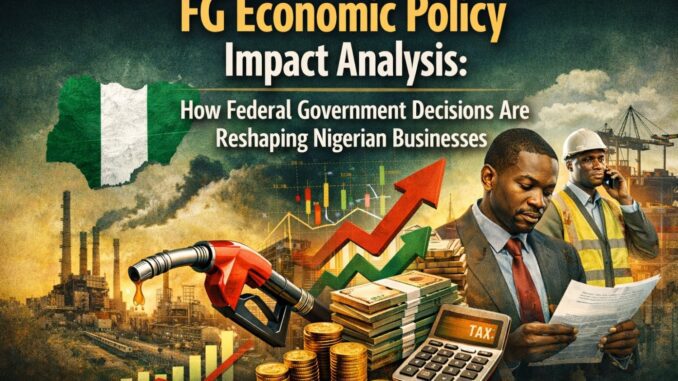
Why Every Nigerian Business Must Understand FG Economic Policy
If you operate a business in Nigeria today, federal economic policy is no longer background noise. It is strategy.
It determines:
- How much you spend on fuel.
- How much your imported inputs cost.
- How expensive your bank loans become.
- How much tax you remit.
- Whether consumers can afford your product.
- Whether investors are confident enough to fund expansion.
The Nigerian economic environment has changed structurally in recent years. The removal of petrol subsidy, exchange rate unification, tightening monetary policy, expanded tax enforcement, and rising public debt have collectively reshaped the operating landscape.
A proper FG economic policy impact analysis is not about politics. It is about understanding how macroeconomic decisions cascade into microeconomic realities for Nigerian businesses.
This article provides a rigorous, evidence-based, Nigeria-specific breakdown of:
- Fiscal reforms and business cost implications
- Exchange rate restructuring and import exposure
- Interest rate policy and financing costs
- Inflation dynamics and consumer behavior
- Tax policy and compliance pressure
- Sector-by-sector business impact
- Long-term growth sustainability
1. The Structural Shift: Nigeria’s Policy Reset Since 2023
Nigeria’s economic direction shifted significantly following key reform decisions:
Major Policy Changes
- Removal of petrol subsidy
- Exchange rate unification
- Monetary tightening (interest rate hikes)
- Aggressive revenue mobilization
- Public debt restructuring efforts
These policies aim to correct long-standing distortions:
- Artificial energy pricing
- Multiple exchange rate windows
- Oil revenue dependency
- Fiscal deficits
According to the World Bank Nigeria Development Update (2023–2024), Nigeria’s reforms were necessary to stabilize fiscal balances and restore macroeconomic credibility.
However, necessary reforms do not automatically mean painless transitions.
2. Fuel Subsidy Removal: Fiscal Discipline vs Business Cost Shock
The Policy Objective
Nigeria spent trillions of naira annually on fuel subsidies. According to data from the Budget Office of the Federation, petrol subsidy payments exceeded ₦4 trillion in some recent years prior to removal.
Subsidy removal aimed to:
- Reduce fiscal pressure
- Redirect spending toward infrastructure
- Improve transparency
Immediate Business Impact
Once subsidy was removed, fuel prices adjusted toward market levels.
Business Consequences
- Transportation costs surged.
- Logistics companies increased tariffs.
- Manufacturing input distribution became more expensive.
- Generator-dependent firms saw operating expenses jump.
For SMEs with narrow margins, this was not incremental. It was structural.
Physical Example 1: Lagos-Based Distribution Company
A mid-sized FMCG distribution company in Lagos that supplies supermarkets across Southwest Nigeria experienced:
- 85% increase in diesel costs.
- 60% increase in interstate transport charges.
- 30% rise in warehousing overhead.
The company initially tried to absorb costs but eventually raised product prices by 18%. Sales volume dropped by 12% due to weakened consumer demand.
This illustrates a key principle:
When policy raises operating costs in an inflation-sensitive economy, businesses face a margin-demand tradeoff.
3. Exchange Rate Liberalization: Currency Risk Becomes Business Risk
Nigeria previously operated multiple exchange rate windows. FX reform aimed to unify the market.
According to the Central Bank of Nigeria (CBN), exchange rate unification was necessary to improve transparency and attract foreign capital.
Short-Term Effects
- Sharp depreciation of the naira.
- Increased import costs.
- Higher production expenses.
- Imported inflation.
Why This Matters for Nigerian Businesses
Nigeria remains heavily import-dependent for:
- Raw materials
- Machinery
- Pharmaceutical inputs
- Technology tools
- Automotive parts
When the naira depreciates, cost structures reset.
Physical Example 2: Pharmaceutical Importer in Abuja
A pharmaceutical distributor importing essential drugs experienced:
- 70% increase in import costs after FX adjustment.
- Working capital needs doubled.
- Retail pricing increased significantly.
Although revenue rose nominally, real profit margins shrank because:
- Demand softened.
- Delayed payments increased.
- FX volatility complicated planning.
This demonstrates how exchange rate reform improves macro transparency but increases micro volatility.
4. Inflation: The Dual Shock on Costs and Consumer Demand
According to the National Bureau of Statistics (NBS), inflation surged significantly following fuel and FX reforms.
Inflation affects businesses in two critical ways:
1. Input Cost Escalation
Raw materials, rent, wages, energy, transportation — all increase.
2. Consumer Purchasing Power Decline
When households spend more on food and transport, discretionary consumption falls.
Businesses in:
- Hospitality
- Fashion
- Luxury retail
- Electronics
face demand contraction.
Economic Insight
Inflation is not uniform. Food inflation often outpaces core inflation in Nigeria (NBS data). This means low-income households are hit harder, compressing consumer spending further.
5. Interest Rate Tightening: The Credit Squeeze
To manage inflation, the CBN raised the Monetary Policy Rate (MPR) multiple times between 2023 and 2025.
Higher interest rates result in:
- Increased loan repayment burden.
- Reduced new borrowing.
- Slower expansion.
- Tighter credit conditions.
For SMEs reliant on overdrafts or short-term financing, finance cost now consumes a larger share of operating revenue.
Business Strategy Adjustment
- Reduce unnecessary debt.
- Focus on cash flow management.
- Improve inventory turnover cycles.
- Seek equity or partnership funding alternatives.
Essential Tools and Strategic Tips to Grow Your Consulting Business in Nigeria (2026 Guide)
6. Tax Revenue Expansion: Compliance Pressure Intensifies
As oil revenues fluctuate, the FG has strengthened non-oil revenue mobilization.
According to the Federal Inland Revenue Service (FIRS), tax collection has significantly increased due to digital monitoring and enforcement reforms.
Implications for Businesses
- Increased audits.
- Stricter VAT enforcement.
- Corporate tax scrutiny.
- Reduced tolerance for informal operations.
Structural Shift
Operating informally now carries higher risk.
Businesses that fail to maintain proper records face penalties, back taxes, and legal complications.
7. Public Debt and Fiscal Sustainability
Nigeria’s public debt has grown substantially in recent years.
According to the Debt Management Office (DMO), debt servicing consumes a large percentage of federal revenue.
When debt servicing absorbs fiscal space:
- Infrastructure projects may slow.
- Government contractors may face payment delays.
- Social programs may be constrained.
For businesses relying on public contracts, fiscal tightening increases liquidity risk.
8. Sector-Specific Impact Analysis
Manufacturing
- High energy dependence.
- FX exposure.
- Infrastructure limitations.
Manufacturers must improve efficiency or face margin compression.
Agriculture
- Fuel cost impacts transport.
- Fertilizer costs rise.
- Opportunity for local substitution exists.
Technology Startups
- FX exposure for foreign tools.
- Venture capital caution.
- Talent wage pressure.
Retail And Trade
- Reduced consumer demand.
- Inventory volatility.
- Increased working capital requirements.
9. Investor Confidence and Policy Credibility
One of the main objectives of recent reforms is restoring macroeconomic credibility.
International institutions including the IMF and World Bank have acknowledged that subsidy removal and FX reforms align with long-term stabilization objectives.
However, investor confidence depends on:
- Policy consistency.
- Institutional transparency.
- Anti-corruption enforcement.
- Regulatory predictability.
Frequent policy reversals weaken credibility.
10. Are These Policies Sustainable?
From a macroeconomic standpoint:
Positive indicators include:
- Improved fiscal transparency.
- Reduced subsidy burden.
- FX market rationalization.
- Stronger revenue enforcement.
Challenges remain:
- Inflation control.
- Poverty mitigation.
- Infrastructure deficits.
- Weak purchasing power.
Reforms are necessary but incomplete.
Essential Tools and Strategic Tips to Grow Your Consulting Business in Nigeria (2026 Guide)
11. What Nigerian Businesses Must Do Now
Given the structural shift, survival requires strategic adjustment:
1. Strengthen Financial Discipline
Improve bookkeeping and cash flow forecasting.
2. Build Pricing Flexibility
Include cost buffers for FX and energy volatility.
3. Reduce Import Dependency
Explore local sourcing alternatives.
4. Invest in Efficiency
Automation and process optimization reduce cost pressures.
5. Enhance Compliance
Proactive tax planning avoids penalties.
12. Long-Term Outlook: Adjustment Before Stability
Economic reforms often follow a pattern:
- Structural distortion correction.
- Inflation spike.
- Policy tightening.
- Gradual stabilization.
- Growth rebound.
Nigeria appears to be in the adjustment phase.
The real question is whether policy consistency will be maintained long enough to reach stabilization.
Conclusion: Understanding FG Economic Policy as Business Strategy
FG economic policy impact analysis shows that Nigeria’s economy is undergoing structural transformation.
The operating environment now features:
- Market-driven pricing.
- Reduced subsidy protection.
- Stronger tax enforcement.
- FX volatility.
- Tighter credit.
These are not temporary disruptions.
They represent a reset.
Businesses that understand policy direction early and adapt strategically will survive and grow. Those waiting for a return to past conditions may struggle.
Economic policy is no longer abstract governance. It is operational strategy.
References
- National Bureau of Statistics (NBS) Inflation Reports
- Central Bank of Nigeria (CBN) Monetary Policy Communiqués
- Debt Management Office (DMO) Public Debt Reports
- Budget Office of the Federation Fiscal Data
- World Bank Nigeria Development Update (2023–2024)
- Federal Inland Revenue Service (FIRS) Revenue Reports
Frequently Ask Questions (FAQs)
What is FG economic policy impact analysis in Nigeria?
FG economic policy impact analysis in Nigeria is the assessment of how Federal Government decisions—such as fuel subsidy removal, exchange rate reforms, tax policies, and interest rate changes—affect businesses, inflation, employment, and economic growth. It helps business owners understand how national policies translate into operating costs, pricing, and profitability.
How do FG economic policies affect businesses in Nigeria?
FG economic policies affect businesses in Nigeria by changing fuel prices, exchange rates, borrowing costs, tax obligations, and consumer spending power. These policies influence how much businesses spend on operations, how easily they access credit, how they price products, and whether they can expand or retain staff.
Why do FG economic reforms increase prices and business costs?
FG economic reforms increase prices and business costs because they remove subsidies, liberalize exchange rates, and tighten monetary policy. While these actions improve fiscal sustainability and transparency, they raise energy costs, import prices, and loan interest rates, leading to higher production and distribution expenses in the short term.
Are FG economic policies good for Nigerian businesses in the long run?
FG economic policies can be good for Nigerian businesses in the long run if they remain consistent and are supported by infrastructure development and productivity growth. Although reforms cause short-term cost pressure, they can create a more stable, transparent, and investment-friendly business environment over time.

Leave a Reply