
Introduction: A Familiar Headline with Unfamiliar Results
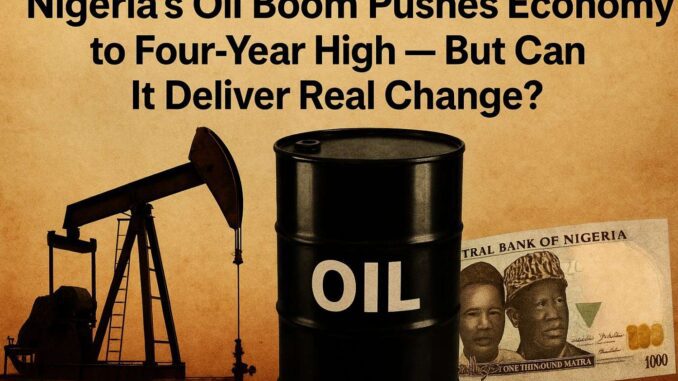
Nigeria, Africa’s largest oil producer, is once again back in the headlines. The economy has just recorded its fastest expansion in four years, with growth largely powered by a surge in crude oil output and favorable global oil prices. For policymakers, this is a cause for celebration. But for the ordinary Nigerian on the street, the reality looks unchanged: rising food prices, costly fuel, unemployment, and a naira that continues to stumble.
The Nigeria oil economy drives GDP growth, but many citizens still face high costs and limited jobs. Businesses benefit from spending and investment inflows, yet volatility remains. Diversifying beyond oil is key to turning this growth into lasting impact.
1. Understanding the Numbers Behind the Growth
The National Bureau of Statistics (NBS) reported that Nigeria’s economy grew by 3.5% in Q2 2025, the highest since 2021. This growth was driven mainly by the oil sector, which expanded by nearly 8% year-on-year after years of decline.
Key Drivers:
- Increased Production: Output rose above 1.7 million barrels per day, up from lows of 1.2 million in 2022.
- Higher Global Prices: Brent crude averaged $88 per barrel in early 2025, up from $72 in 2023.
- Improved Security: Government and private security contractors curbed pipeline vandalism in the Niger Delta.
For Nigeria, whose government revenue and foreign exchange depend heavily on oil, this rebound provided breathing space after years of fiscal stress.
2. Why Oil Still Matters to Nigeria
Despite decades of policy speeches about “diversification,” oil remains Nigeria’s economic backbone:
- 90% of export earnings come from oil.
- Around 50% of government revenue is petroleum-derived.
- Oil contributes only 6–8% of GDP directly, but it indirectly supports most other sectors through foreign exchange.
This heavy reliance means that any significant swing in oil production or prices can tilt the entire economy toward growth or crisis.
Example:
In 2020, during the COVID-19 pandemic, oil prices crashed below $40 per barrel. Nigeria’s GDP shrank by 1.8%, foreign reserves fell, and the naira was devalued. Fast-forward to 2025, the opposite is happening — higher prices and production are temporarily boosting growth.
3. The Historical Rollercoaster of Nigeria’s Oil Economy
Nigeria discovered oil in 1956, and since then, crude has defined its economic trajectory.
- 1970s Oil Boom: With prices above $100 (in today’s value), Nigeria’s economy surged. But massive corruption and white-elephant projects swallowed the wealth.
- 1980s–1990s Crises: Oil price collapses triggered structural adjustment programs (SAP) under the IMF and World Bank. The naira was devalued, poverty deepened, and industries collapsed.
- 2000s Windfall: Rising prices brought billions in revenue. Yet, poverty rates remained stubbornly high, proving that oil wealth didn’t trickle down.
- 2014–2016 Crash: Oil prices halved, Nigeria entered recession. The impact revealed how vulnerable the economy was to external shocks.
- 2020 Pandemic: Global demand collapsed, and Nigeria recorded its worst recession in decades.
This cyclical boom-and-bust pattern continues today, raising doubts about whether the latest rebound will be any different.
4. The Global Context: Oil as Both a Blessing and a Trap
Nigeria’s story is not unique. Other oil-dependent economies face similar dilemmas:
- Saudi Arabia: Experienced massive growth from oil, but has actively diversified through Vision 2030, investing in tourism, technology, and renewable energy.
- Venezuela: Overreliance on oil led to economic collapse when prices fell, compounded by poor governance.
- Angola: Another African producer, Angola, saw a GDP boom in the 2000s, but like Nigeria, it remains heavily reliant on crude.
- Ghana: Discovered oil in 2007, but struggled with debt and fiscal instability, showing that oil alone doesn’t guarantee prosperity.
These global examples underline a lesson: oil can be an accelerator of growth, but without strong institutions and diversification, it can just as easily trap nations in cycles of volatility.
5. Everyday Nigerian Reality: Disconnect Between GDP and Daily Life
While economists celebrate growth figures, most Nigerians ask: “Where is the impact?”
- Food Inflation: Food inflation remains above 35%, making staples like rice and garri unaffordable for millions.
- Transportation Costs: With fuel subsidy removal in 2023, petrol prices more than doubled, driving up bus fares and delivery costs.
- Wages: Salaries have stagnated. The new minimum wage of ₦65,000 (introduced in 2024) has already lost much of its purchasing power.
- Youth Unemployment: Still hovers around 40%, leaving millions idle despite “economic growth.”
MORE LEASON: Slowing Inflation: A Ray of Hope or Just Another Mirage for Nigerians?
Case Study:
Ngozi, a trader in Lagos, explains: “They say the economy is growing. But I still buy rice at ₦55,000 a bag. Transport from Mile 12 to Mushin costs more. How is this growth helping me?”
Her story reflects the skepticism of millions: oil growth often enriches elites and boosts government budgets but does little to lower the cost of living.
6. Risks That Could Undermine the Growth
Nigeria’s oil rebound, though impressive, is fragile.
- Oil Theft: Reports suggest that over 200,000 barrels per day are still lost to theft.
- Pipeline Vandalism: Sabotage in the Niger Delta remains a risk, with militancy simmering beneath the surface.
- Global Volatility: If prices fall below $70, Nigeria’s revenues could collapse again.
- Climate Transition: The global shift toward renewable energy poses a long-term risk to oil-dependent economies.
- Weak Infrastructure: Nigeria still imports almost all refined petroleum, eroding gains from crude exports.
7. The Dangote Refinery Factor
The Dangote Refinery, commissioned in 2024, is expected to process 650,000 barrels per day. If fully operational, it could:
- Cut Nigeria’s dependence on imported refined fuel.
- Stabilize fuel prices domestically.
- Save billions in foreign exchange.
However, skeptics argue that without strong regulation, monopoly pricing and operational challenges may limit the refinery’s benefits.
8. Lessons from the 2000s Oil Boom
In the mid-2000s, when oil prices were above $100 per barrel, Nigeria experienced record revenues. Yet:
- Corruption swallowed billions in oil funds.
- Infrastructure remained underdeveloped.
- Poverty worsened, with over 70 million Nigerians still poor by 2010.
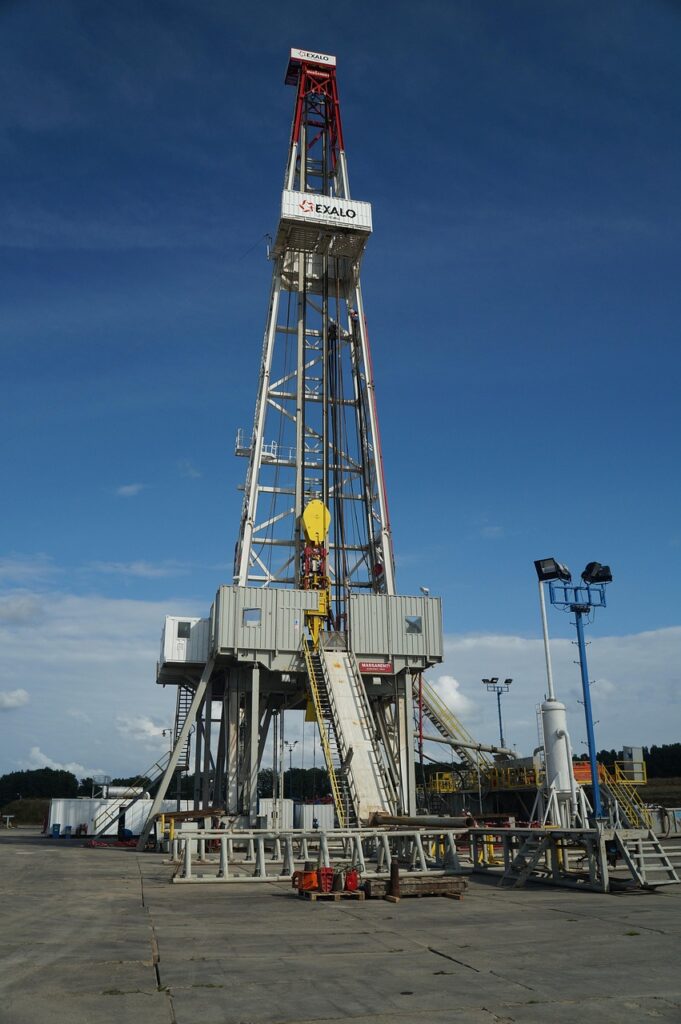
The fear today is that history will repeat itself: record oil growth, but no real transformation.
9. What Needs to Change?
For Nigeria to turn oil growth into meaningful development:
- Fiscal Discipline: Transparent use of oil revenues. The Excess Crude Account (ECA), once a buffer, has been depleted — it must be rebuilt.
- Diversification: Investment in agriculture, technology, and manufacturing.
- Infrastructure Investment: Roads, power supply, and railways to reduce business costs.
- Human Capital: Funding education and healthcare to build a resilient workforce.
- Green Transition: Prepare for a world less reliant on fossil fuels.
10. Global Case Studies Nigeria Can Learn From
- Brazil (1990s): Stabilized its currency and invested in diversified exports.
- Norway: Used oil revenues to build the world’s largest sovereign wealth fund, ensuring future generations benefit.
- United Arab Emirates: Diversified into tourism, real estate, and aviation, reducing oil dependence.
Nigeria has the population, talent, and resources to emulate these models — but only if corruption and mismanagement are curbed.
11. Looking Ahead: Hope or Mirage?
The oil sector has lifted Nigeria’s growth to a four-year high. But growth on paper is not enough. For ordinary Nigerians, hope lies in whether this rebound:
- Reduces inflation.
- Strengthens the naira.
- Creates jobs.
- Improves living standards.
Otherwise, it risks becoming another cycle in Nigeria’s “resource curse” — rich in oil, but poor in development.
References
- National Bureau of Statistics (NBS), Nigeria (2025 GDP Report).
- World Bank Nigeria Development Update, June 2024.
- International Monetary Fund (IMF) Sub-Saharan Africa Regional Outlook, 2024.
- Financial Times (2025), “Nigeria’s Oil Production Recovery.”
- Brookings Institution (2023), “Resource Dependence and the African Economy.”
- OPEC Monthly Oil Market Reports, 2024–2025.
- Reuters (2025), “Dangote Refinery and Nigeria’s Oil Future.”
Nigeria’s economy is shifting — but do these changes truly reflect in your day-to-day life?
We’d love to hear your story. Share your thoughts in the comments and connect with others facing the same challenges.
Don’t forget: Biznalytiq publishes weekly insights on personal finance, side hustles, entrepreneurship, and the bigger economic picture — all designed to help you stay informed and ahead.

Leave a Reply