

Introduction
The business world is evolving faster than ever. Digital disruption, artificial intelligence (AI), sustainability, and new consumer expectations are rewriting the rules of growth. For Nigerian businesses, these trends bring both challenges and opportunities, while global companies are already experimenting with models that could soon reshape Africa’s markets.
In this article, we’ll explore future-focused business case studies that highlight how innovation, sustainability, and technology will drive growth in Nigeria and across the world.
1. Artificial Intelligence in Banking – Access Bank (Nigeria) vs. JPMorgan Chase (USA)
Access Bank (Nigeria):
- Recently launched AI-powered chatbots for customer support.
- Investing in data analytics to detect fraud and personalize services.
- The bank is positioning itself as a digital-first institution.
JPMorgan Chase (USA):
- Uses AI for risk analysis, fraud detection, and trading algorithms.
- Launched COIN (Contract Intelligence) to review legal documents in seconds.
Future Insight:
Nigerian banks must scale AI adoption beyond customer service—using it for credit scoring, fraud detection, and investment insights like global banks.
2. Renewable Energy & Sustainability – Lumos (Nigeria) vs. Tesla Energy (USA)
Lumos (Nigeria):
- Provides solar home systems for off-grid communities.
- Tackles Nigeria’s chronic electricity challenges.
Tesla Energy (USA):
- Expanding solar roofs and Powerwall batteries.
- Aims to create fully sustainable households and cities.
Future Insight:
Businesses that solve climate and energy challenges will dominate the next decade. Nigeria has untapped potential in renewable energy.
3. E-Commerce Evolution – Paystack Integration (Nigeria) vs. Shopify (Global)
Nigeria (Paystack + Local E-commerce):
- Paystack enables SMEs to accept digital payments.
- Nigerian businesses are increasingly adopting Instagram stores and online shops.
Shopify (Global):
- Simplifies e-commerce for millions of merchants.
- Provides AI-driven insights, dropshipping options, and global logistics solutions.
Future Insight:
Nigerian SMEs must integrate AI-driven personalization and better logistics to scale like Shopify merchants.
4. AgriTech & Food Security – ThriveAgric (Nigeria) vs. Indigo Agriculture (USA)
ThriveAgric (Nigeria):
- Crowdfunds agriculture projects by connecting farmers with investors.
- Uses data to predict yields and reduce waste.
Indigo Agriculture (USA):
- Uses AI and biotech to improve crop resilience.
- Links farmers directly to global markets via digital platforms.
Future Insight:
Food security will be a defining issue. African agri-tech must scale data-driven farming to match global food innovation.
5. Logistics & Last-Mile Delivery – GIG Logistics (Nigeria) vs. Amazon Prime (Global)
GIG Logistics (Nigeria):
- Builds infrastructure for e-commerce delivery in Nigeria.
- Introduced app-based parcel tracking and efficient last-mile services.
Amazon Prime (Global):
- Sets global standards with same-day and drone deliveries.
- Invests in robotics and automation for speed.
Future Insight:
Nigeria’s logistics sector needs automation, AI routing, and partnerships with e-commerce to compete globally.
RELATED:
CBN Takes Direct Control of Nigeria’s Fixed-Income Market to Boost Transparency
How Startups Are Winning with Smart Capital Strategies
Role of Analytics in Business Growth: Driving Smarter Decisions and Profits
In Conclusion
The next decade of business case studies will focus less on “traditional success” and more on future readiness. Key lessons include:
- AI adoption will separate leaders from laggards.
- Sustainability is not optional—it’s a business advantage.
- E-commerce in Nigeria must evolve from basic transactions to personalized, global-scale platforms.
- Agritech and logistics will define Africa’s role in global trade.
Whether you’re a Nigerian entrepreneur or a global business leader, the message is the same: The future belongs to businesses that innovate, adapt, and scale responsibly.
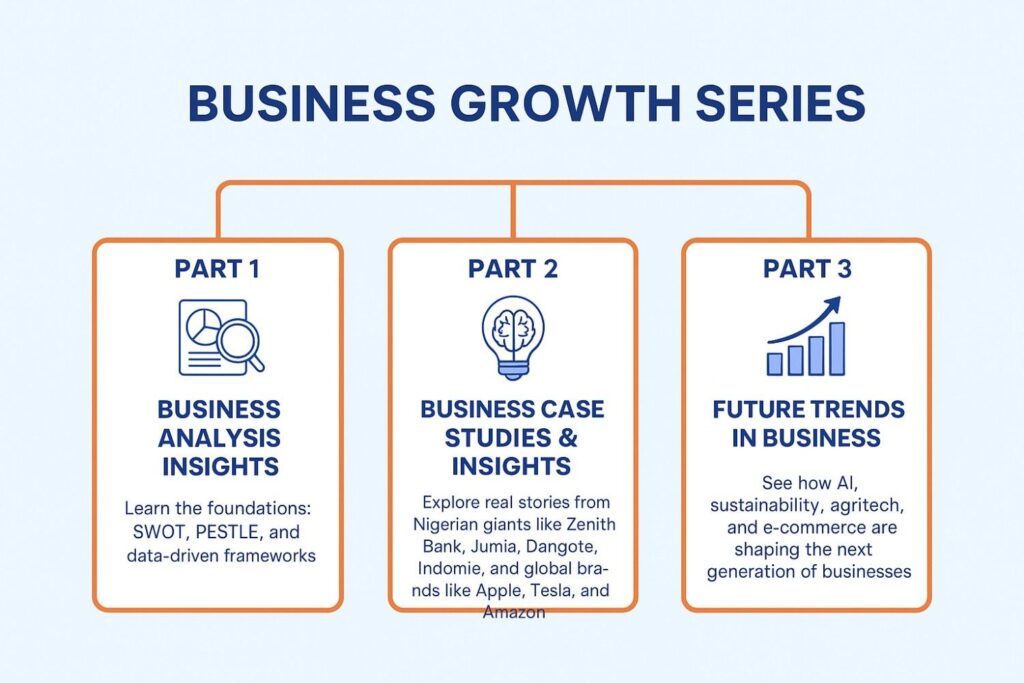
If you want to understand the foundations behind these strategies, revisit our Business Analysis Insights guide.

Leave a Reply