

Business success isn’t about guesswork—it’s about strategy, execution, and the ability to adapt. One of the best ways to learn is by studying real businesses, looking at how they handled challenges, seized opportunities, and sometimes failed before bouncing back stronger.
In this post, we’ll explore different case studies from Nigeria and across the globe, with clear insights you can apply whether you run a startup, an SME, or a multinational company.
Case Study 1: Zenith Bank’s Push into Digital Banking (Nigeria)
The Situation
By the late 2010s, Nigerian banks faced pressure from rising fintechs. Customers wanted mobile-first solutions, but traditional banks were slow to change.
The Move
Zenith Bank doubled down on digital transformation—launching a modern mobile app, improving USSD banking (966#), and investing in cybersecurity to build trust.
The Result
- Reduced branch dependency.
- Millions of customers now use its mobile and internet platforms.
- It became one of Nigeria’s most tech-driven traditional banks.
Insight: Traditional businesses that embrace change early can compete with disruptors instead of being wiped out.
Case Study 2: Jumia’s Struggles and Adaptation (Nigeria)
The Situation
Jumia entered Nigeria with massive funding, aiming to be the “Amazon of Africa.” But it faced logistics nightmares, cash-on-delivery fraud, and poor internet penetration.
The Move
Instead of pulling out, Jumia pivoted—focusing on JumiaPay (fintech services) and Jumia Logistics. They also shifted towards essentials like food delivery during the pandemic.
The Result
- JumiaPay grew into a strong revenue driver.
- Jumia Logistics expanded beyond e-commerce.
- While profitability is still a challenge, the company found niches to survive.
MORE RELATED: Business Case Studies & Insights: Lessons from Nigeria and the Global Market
Insight: Sometimes survival means pivoting into side opportunities that become main businesses.
Case Study 3: Shoprite’s Exit from Nigeria (Nigeria)
The Situation
Shoprite entered Nigeria in 2005, expanding quickly into malls across major cities. But they struggled with inflation, currency devaluation, and supply chain issues.
The Move
By 2020, Shoprite announced it was exiting Nigeria, selling its stores to local investors who rebranded them.
The Result
- Shoprite reduced exposure to difficult African markets.
- Nigerian retailers took over operations.
- Customers saw mixed reactions—some stores declined in quality.
Insight: Global brands must localize operations deeply; without adapting to the realities of a market, even giants can fail.
Case Study 4: Dangote Refinery’s Mega Project (Nigeria)
The Situation
Nigeria, Africa’s top crude oil producer, still imported refined fuel, costing billions annually.
The Move
Aliko Dangote invested over $19B to build the largest single-train refinery in the world, located in Lagos.
The Result
- Once fully operational, it is expected to meet local fuel demand and reduce imports.
- It positions Nigeria as a regional hub for refined petroleum.
- Despite delays, it remains Africa’s most ambitious private industrial project.
Insight: Solving big national problems creates long-term business opportunities, even if the short-term challenges are huge.
Case Study 5: Apple’s Ecosystem Lock-In (Global)
The Situation
Apple faced competition from cheaper smartphone makers like Samsung, Huawei, and Xiaomi. Many predicted it would lose dominance due to high prices.
The Move
Instead of competing only on price, Apple built an ecosystem—iPhone + iPad + Mac + iCloud + App Store—making it hard for users to leave once inside.
The Result
- Apple became the world’s first $3 trillion company.
- Customer loyalty remains among the strongest in tech.
- Services (iCloud, Apple Music, App Store) generate recurring revenue.
Insight: Building an ecosystem around your product increases customer lifetime value and reduces churn.
Case Study 6: Starbucks’ Global Expansion (Global)
The Situation
Starbucks was already successful in the US, but its global expansion faced risks—coffee culture is different in every country.
The Move
Starbucks localized its strategy:
- In China, they introduced larger group seating and tea-based drinks.
- In Middle East countries, they respected cultural norms while creating a premium café feel.
The Result
- Starbucks became the world’s largest coffee chain.
- Local adaptation fueled acceptance in diverse cultures.
Insight: Global growth requires local customization, not a one-size-fits-all approach.
Case Study 7: Tesla’s Bet on Electric Vehicles (Global)
The Situation
For decades, electric cars were seen as impractical. Oil companies dominated, and automakers stuck to fuel engines.
The Move
Elon Musk pushed Tesla into EVs, betting on technology, battery innovation, and a strong brand image.
The Result
- Tesla became the most valuable carmaker in the world.
- It forced traditional automakers (Ford, Toyota, Volkswagen) to shift to EVs.
- Despite controversies, Tesla shaped the future of mobility.
Insight: Taking bold bets on future trends can turn small players into global leaders.
Case Study 8: Indomie’s Cultural Domination (Nigeria & Global)
The Situation
Instant noodles weren’t originally Nigerian cuisine. When Indomie entered, many doubted its success.
The Move
Indomie invested in aggressive marketing, local flavors (like Jollof Chicken), and distribution into small kiosks across Nigeria.
The Result
- Indomie became a household name.
- Nigeria is now the largest instant noodles market in Africa.
- Indomie is a cultural icon, not just a product.
Insight: Products that integrate into local culture become more than goods—they become traditions.
Common Lessons Across These Case Studies
- Adaptation Wins – Zenith Bank, Jumia, and Starbucks show that flexibility is key.
- Solve Big Problems – Dangote Refinery and Tesla succeeded by tackling national/global challenges.
- Customer-Centric Models – Apple and Indomie thrive because they deeply understand what customers value.
- Global ≠ Universal – Shoprite failed where Starbucks succeeded because one adapted while the other didn’t.
- Bold Investments Pay Off – Dangote and Tesla prove that high-risk projects can reshape industries.
READ ALSO:
Top 7 Business Loans in Nigeria Without Collateral (2025 Guide)
How to Open a Corporate Bank Account in Nigeria, Step-by-Step (2025 Guide)
2025 Guide: Proven Digital Marketing Strategies for Small and Medium Businesses in Nigeria
Final Thoughts
Business case studies are not just stories; they’re playbooks for entrepreneurs and executives. From Nigeria to Silicon Valley, the lessons are clear:
- Listen to your customers.
- Adapt faster than competitors.
- Don’t fear bold bets if they solve real problems.
- Think long-term, not just quarterly profits.
The Big Insight: Whether you’re running a small enterprise in Lagos or a global tech company in California, success comes down to the same principles: vision, adaptability, and execution.
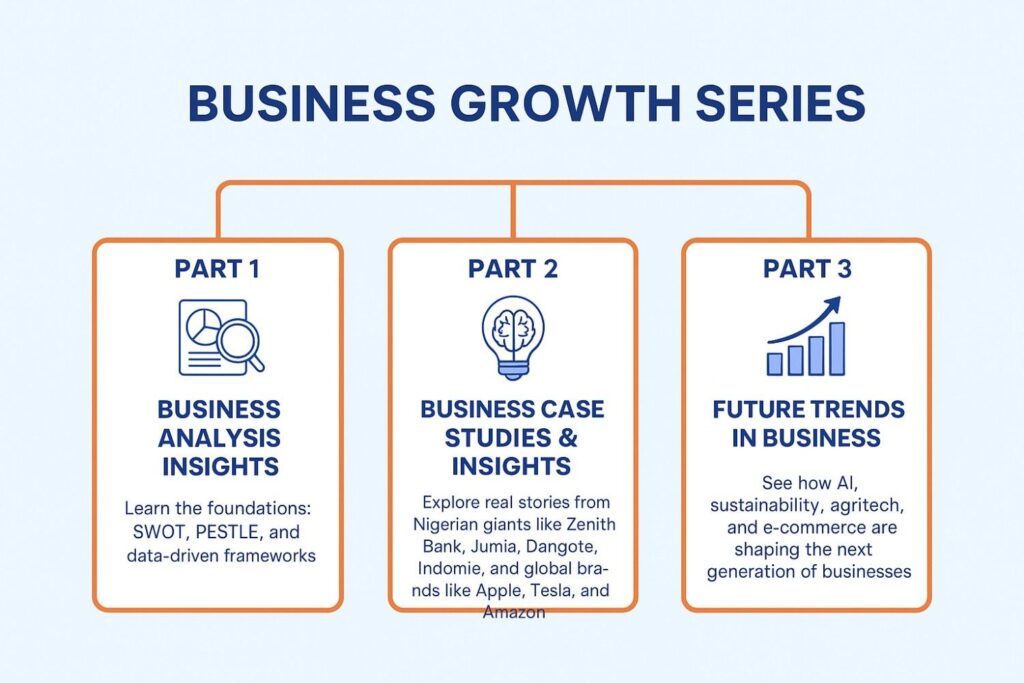
Want to see how real companies apply these frameworks? Check out our Business Case Studies & Insights: Real-World Lessons.

Leave a Reply